7 essential elements for a website measurement plan.

Making dollars and sense from Google website analytics

Google website analytics: love them or hate them, they are here to stay. Interpreting the data those dimensions and metrics provide can be challenging for the analytic novice. To Google’s credit, they do provide online tutorials to help marketers start to think in analytical terms, interpret analytical data, and take the necessary action to achieve the business objective.

Continue reading

Why employees are the best source for inbound marketing content.

Having a process and the right skill set to capture marketing content is half the battle.

Speak with almost any CEO of a small to mid-sized brand, and they will tell you that inbound marketing is an important communication component in creating and maintaining brand preference. However, ask them what resources or processes are in place dedicated to inbound marketing content, and the answer will tell you that this is usually more wishful thinking than reality.

Why is this? Small and mid-sized brands are resource-challenged. Their employees have a wealth of knowledge to share but usually there is no process in place to capture content.

Continue reading

Digital Ad Targeting – What Do Marketers Know About You?

More than you suspect – first, second, and third party data

The adoption of programmatic advertising has given rise to digital ad targeting that uses captured data for ad placement across ad exchanges and networks.

This captured data is referred to as first, second, and third party data. Depending on which side of the buy/sell equation you stand on — advertiser or publisher — these terms have different meanings. What is important to keep in mind is just about all programmatic advertising is data driven marketing, with the intent of making more efficient targeted ad buying.

Continue reading

Ad Technology: Programmatic Advertising

Welcome to the high-speed trading desk for automated digital advertising placement

Marketers spent more then $3.37 billion on programmatic advertising last year. eMarketer is estimating the programmatic advertising will top $9 billion by 2017. Research studies by the Association of National Advertisers and Forrester indicated that only 23% of marketers said they used and understood programmatic advertising and that 26% indicated they understood the concept but needed to learn more about how to apply it to campaigns.

Continue reading

Why Business-to-Business Marketing is Transforming to People-to-People Marketing

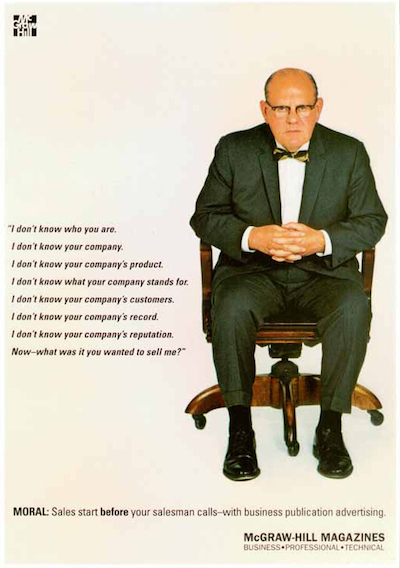
In 1958 McGraw-Hill published the famous “man in the chair ad.” This iconic image served as the rallying cry for decades of business-to-business marketing.

Remember studying “Mass Communications” in college? Mass communications was born out of the industrial revolution when manufacturers learned to make lots of the same thing via the assembly line. Henry Ford’s Rouge Factory was the model of efficiency, producing at times more than 1000 cars a day for a growing country. The assembly line concept also caught on with marketers.

Continue reading

Marketing Automation Platforms (MAPs)

The promise of Marketing Automation Platforms is to integrate and automate marketing functions

Marketing Automation Platforms (MAPs) are receiving lots of attention in the B-to-B marketing sphere. Most of these platforms are targeted toward companies with large database records that execute the majority of their marketing efforts online. For originations that fit the aforementioned criteria, MAPs promise greater marketing efficiency, integration with sales CRM software, reduced external resource expenditures, and ROI tracking for each marketing event.

Continue reading

People-to-people Marketing and “Small Data”

Human insight combined with “Small Data” provides a better customer experience

Devin Wenig, President of eBay Marketplaces recently spoke with McKinsey & Company about how digital technology was transforming the retail marketplace. One of his insights that can apply to companies serving the aviation industry was his take on the importance of small data vs. big data.

Continue reading